The First Tiles: A Proof of Concept

Every great map starts somewhere. Mine starts with cardboard, a marker dropped blind onto a painted surface, and a fistful of dice.
This post walks through the intended process of creating the map — not with the final wooden tiles, but with cardboard proxies, roughly half the size of the wooden hexagons that will eventually make up the real thing. This is a proof of concept: a chance to test the materials, trial the rules, and find the cracks in the system before committing to the actual work.
Cutting and Painting the Blanks
It started simply enough. I measured a hexagonal piece of cardboard, cut a template from it, and used that to produce five blanks. In the final version, these would be the 15-centimetre wooden tiles. For now, cardboard would do.
I gave each blank two coats of white paint — not particularly good paint, but good enough for a proof of concept. In the real process, this is also the stage where the magnets would be attached, each one cushioned with a felt sticker to reduce scratching and make repositioning on the wall smooth and easy.
With the blanks prepared and drying, it was time to roll the dice.


Rolling the Dice
For this prototype run, I used physical dice rather than the number cards. The cards are still being prepared, and I wanted the process to be legible while the rules are still fresh and unfamiliar. I also kept notes in a notepad — scrappy and informal, but enough for now. In the future, something more structured, a spreadsheet perhaps, will keep better track of everything.
Session Initiation: Logging the Work
Each working session begins with an initiation phase, and each session gets logged. The log captures the time and date, a session ID, the title of the previous session, and the dice results. In the future it will also record the coordinates of the target tile and other details still being defined. The goal is simple: to always know exactly what was done, when, and to which tile.
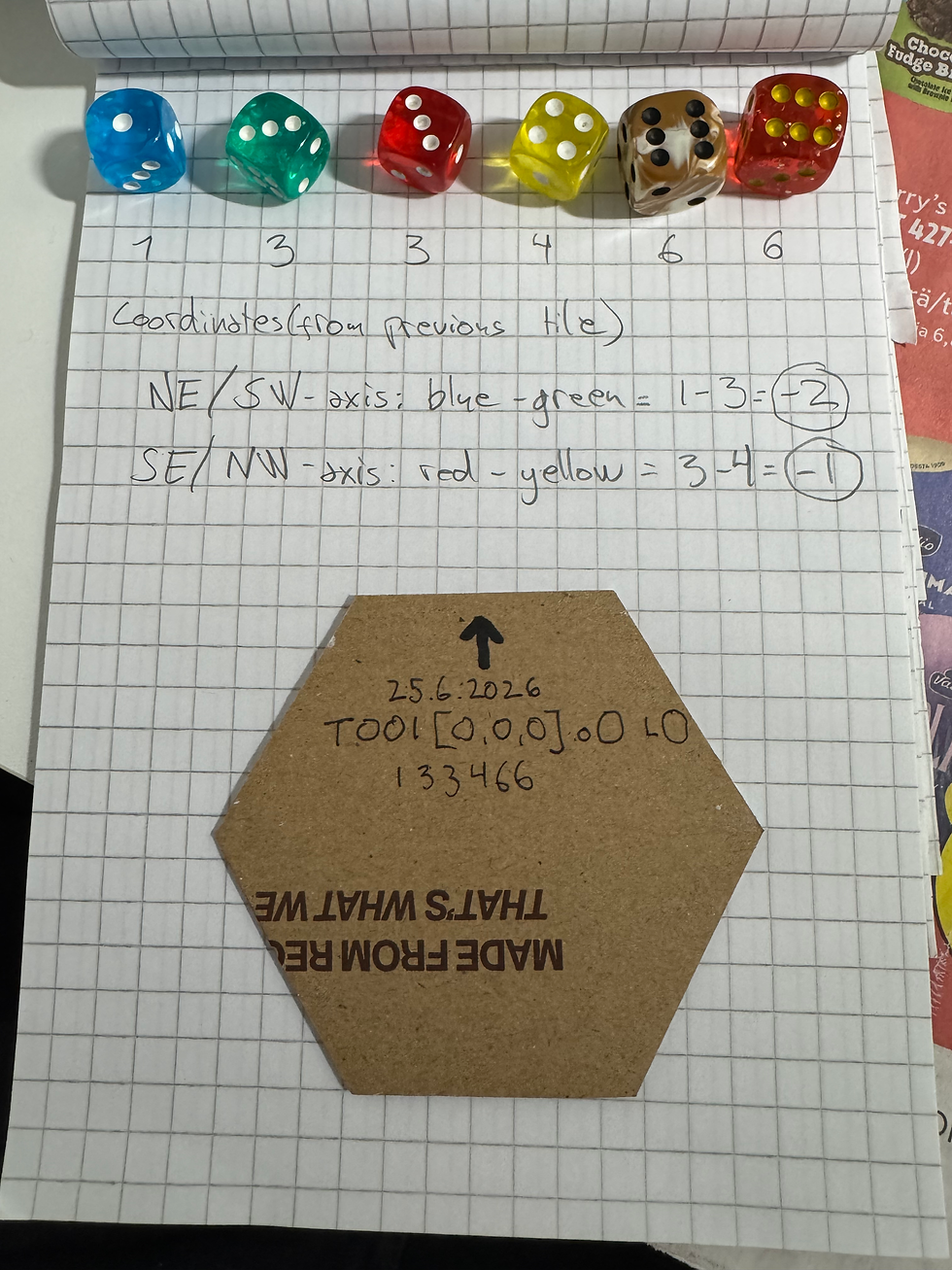
The dice were rolled. The result: blue 1, green 3, red 3, yellow 4, brown 6, and special 6. These numbers would remain active for the entire session, applied wherever the rules called for them.
In the initiation phase, the dice determine the coordinates of the tile being worked on. If the result points to an empty coordinate, a new tile may be born. Since this was the very first tile of the map, the coordinates resolved to [0,0], and the tile was named T001. This tile is now the origin of the entire coordinate system.
The map uses a NE-SW axis and a SE-NW axis, rather than the more familiar x and y. This is a practical concession to the hexagonal grid, where standard axes create more problems than they solve. The NE-SW axis runs from the bottom-left (negative) to the upper-right (positive); the SE-NW axis runs from top-left to bottom-right. In hindsight, the naming could be cleaner — leave a comment if you have thoughts on coordinate systems for hex maps, I'd genuinely love to hear them.
The Base Angle: Giving the Tile Its Own Orientation
Each tile is divided into four quadrants, but these quadrants do not align to compass directions. Instead, they sit at what I call the "base angle" — an orientation unique to each tile, calculated by adding all six dice results together and multiplying by ten.
With the results from this session, that gives a range of 60 to 360 degrees. It is an imperfect system — the average result tends toward 210 degrees — but it introduces enough variation to keep things interesting, and it will do until something better comes along. If you can think of a cleaner system that still uses six d6s, drop it in the comments.
Writing the Tile's Identity
Before any art goes on the front, the back of the tile gets its permanent record: the date, the tile ID, the coordinates [NE-SW, SE-NW, and stack height — not yet in use], any rotation applied to the tile, and the current level of the tile. Right now every tile sits at what I am calling "bedrock" level. A compass arrow pointing north is also added, so that even if the tile is rotated, stored in a box, or disassembled from the map entirely, it can always be returned to exactly the right place with exactly the right orientation.
With the back complete, the tile still needs its quadrants marked on the front.
To place the anchor dot — the centre of the quadrant cross — I closed my eyes and let the marker fall onto the tile. Wherever it landed, that was the spot. A pencil line was then drawn to indicate north. From there, the quadrant cross: one line at the base angle from north, another drawn perpendicular to it, producing four quadrants counted clockwise. Simple, slightly chaotic, and entirely the point.
The initiation phase was complete.

Building the Bedrock
At bedrock level, all work is done with paper and glue. This is the foundation layer — rough, textural, something to build everything else upon.
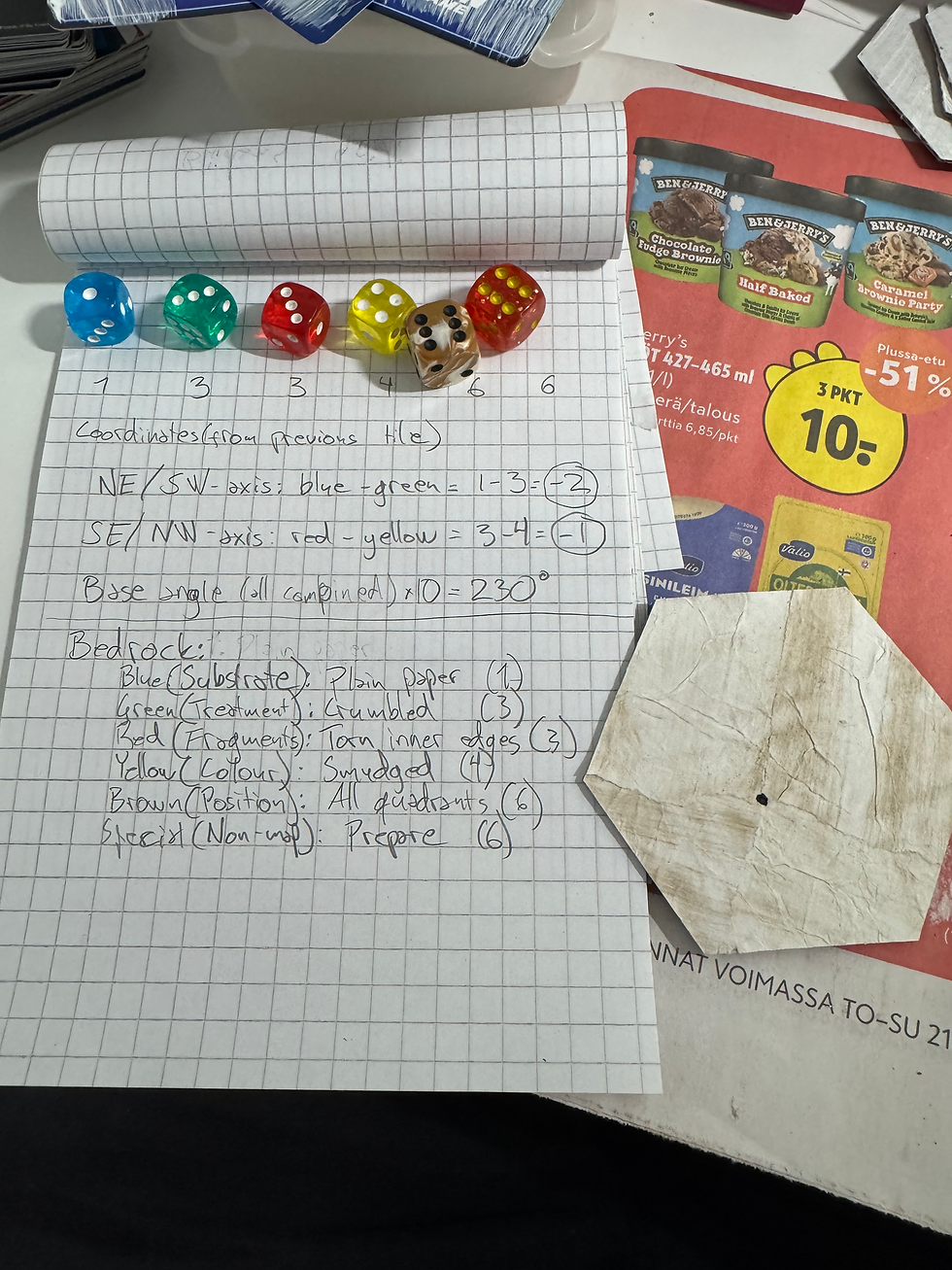
The dice results shaped every decision. Blue 1 determined the base material: plain paper. Green 3 called for "treatment" — the paper was crumpled, then flattened back out. Yellow 4 added a smudged quality to the colour, which I interpreted as rubbing actual dirt into the surface. Red 3 dictated that the inner edges be torn rather than cut.


The result: four pieces of dirty, crumpled, torn paper, one glued into each quadrant. All four quadrants are filled at this stage — that may change in the future, but for now the rule holds.
The Special Die
The finished tile sat there: battered, earthy, marked with a single black dot at its centre. It looked like the beginning of something.
Then came the special die. A result of 6 meant "prepare" — set things up for future sessions. I pulled out an old map book and cut out several pages, along with a few images of planets. The planets were chosen partly for their colour reference value and partly to help in building the number cards, which will make an appearance in a future post.

Where Things Stand
As this is being written, two more tiles have already been made, one of which involved a "sharing" special task — which may or may not be what you are reading right now, still deciding.
Reviewing the work also revealed a missed rule: the second tile was never punctured, as the rules required. These things happen when a system is still being learned. The map will survive.
Drop a comment below. Does the dice system make sense to you? Are you curious to see the cards? And should the full rules be published here on the site?
— Suolenkainen (🤖 Claude Anthropic assisted)


Comments